
Launched in April 2020, USAID’s E-Governance Activity in Bosnia and Herzegovina (BiH) worked on advancing the digital transformation of key government-led processes at the BiH, Federation of BiH, cantonal, and municipal levels. Adopting a comprehensive approach, the Activity supported legal and institutional reforms, raised awareness and government capacity while developing modern IT systems. The aim was to improve efficiency and transparency, and enhance public service delivery across sectors such as trade facilitating inspection services, construction permitting, and public procurement. The five-year, $10.5 million project was implemented by Millennium Partners.
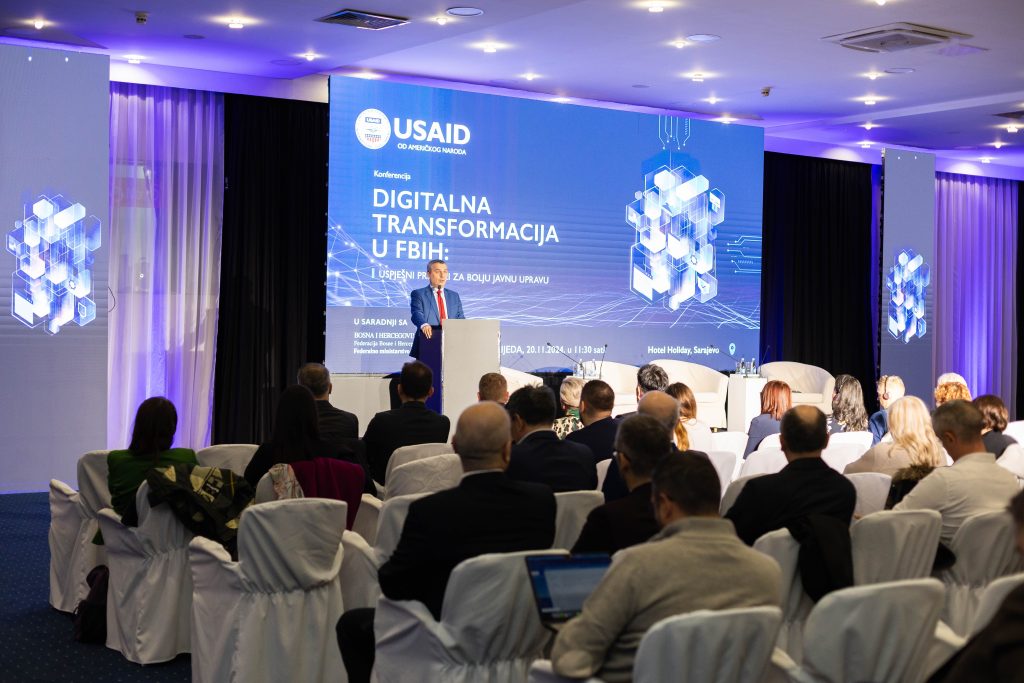

Despite such challenges as the COVID-19 pandemic, political roadblocks, and limited digital infrastructure and capacity, the team achieved impactful results. All IT systems were designed for scalability, enabling roll-out across institutions and ensuring long-term progress and sustainability.
The E-Governance Activity laid a strong foundation for a modern digital government in BiH. With a high return on future investments, its systems and reforms position the country to embrace the digital era, rebuild public trust by improving access to services, boost economic growth, and advance regional and EU integration.
KEY EXPERTISE
Supporting Economic Growth and Democracy:
By supporting greater government accountability and effectiveness Millennium Partners is helping to encourage businesses to invest and trade through faster and more secure processes. Our e-inspections service enables goods to cross borders quickly without cumbersome paperwork and other impediments. By improving border processes, Bosnia and Herzegovina can significantly enhance economic growth, attract investments, and create a more dynamic and competitive economy. Our digital systems also enable and encourage badly needed direct investments with services such as e-construction permitting, e-signature, and an electronic public procurement systems.
By improving G2B services in Bosnia and Herzegovina we are removing long time barriers to economic activity, reducing corruption, increasing revenue, and stimulating job creation. This ultimately fosters sustainable development and poverty reduction, paving the way for long-term prosperity and democratic stability.
Strategic, Legal, and Regulatory Framework for E-Governance:
While many government institutions are eager to embrace digital transformation, they lack the knowledge, capacity, and legal foundation to begin. Through the E-Governance Activity, Millennium Partners helped bridge this gap by guiding institutions through the essential first steps—raising awareness, building trust, and demonstrating what digital governance can look like in practice. What started as initial outreach evolved into a strategic effort that included stakeholder trainings, live demonstrations, and study visits to Estonia, Croatia, Slovenia, and Montenegro, introducing officials to international best practices and standards. At the same time, the Activity spearheaded critical legislation, including a major update to the Law on Administrative Procedure, legislation related to construction permitting and centralized public procurement, while helping to enable e-signature, e-communication, and interoperability of systems. These efforts produced a strong legal and institutional foundation — one that assigns clear responsibilities and enables sustained digital transformation.
Inspection Services in FBIH:
In partnership with the Federal Administration for Inspection Affairs, the E-Governance Activity worked on developing two advanced digital systems: the Border Inspections Management System (BIMS 2) in use since May 2023 and the Inspection Management System (E-INSPECTOR 2). These tools were designed to streamline inspection oversight by enabling real-time data exchange between institutions, improving detection of irregularities, and allowing businesses to self-assess legal compliance. The systems introduce Cloud-based technologies, secure digital document handling, and advanced cybersecurity solutions. By providing federal inspectors with new IT equipment and automating outdated processes, the project helped improve transparency, efficiency, and regulatory enforcement. Ultimately, digitalization helps facilitate faster movement of goods, contributing to safer, more reliable cross-border trade and a stronger business environment in BiH.
Construction Permitting:
USAID’s E-Governance Activity designed a state-of-the-art e-Construction Permits System to modernize and simplify the permitting process across all levels of government in BiH. The system enables faster submission, approvals, standardized procedures, and clearly defined responsibilities, including electronic communication with other relevant institutions. Citizens and businesses can electronically submit permit requests, upload documentation, e-sign applications, and track progress—anytime, from anywhere. For institutions, the system improves efficiency, transparency, and digital oversight. Scalable and ready for expansion beyond pilot municipalities, this digital solution contributes to increased construction projects, attracts investments, creates jobs, and restores public trust.
E-Governance Platform:
To support end-to-end digital delivery, the Activity also developed an enterprise-level e-Governance Platform, which includes building blocks such as e-Identification, e-Signature, and a centralized Service Delivery Platform. This represents a critical milestone in establishing the digital infrastructure needed for seamless and citizen-friendly access to government services.
Public Procurement:
In partnership with the BiH Public Procurement Agency, the E-Governance Activity focused on strengthening transparency, cost-efficiency, and accountability in public procurement. The e-Centralized Public Procurement System (e-CPP) has been operational since April 2024 and is in use by several pilot cantons that have established Centralized Purchasing Bodies. Its implementation was made possible through the adoption of a state-level regulation by the BiH Council of Ministers.
To enhance oversight, the Activity also designed a digital monitoring and analysis tool. Its modules provide access to critical procurement data for key actors, including the Public Procurement Agency, investigative authorities, and civil society. Leveraging Microsoft Power BI and open data, the tool helps identify trends and flag potential irregularities.
Finally, the Contractor Vendor Past Performance Report System (e-CPARS)—an electronic register of contractor performance—was developed to improve transparency and integrity in the public bidding process and to ensure that public money is well spent by identifying the best-qualified bidders.
Civil Society Engagement:
Building the capacity of selected CSOs to more effectively monitor and report on government processes was a key element of the E-Governance Activity’s objective to reduce corruption in public procurement and other government processes. The Activity provided training to CSOs to analyze and interpret data from digital systems developed under the Activity, and strengthened the technical capabilities of relevant government institutions to better detect, evaluate, and report corruption risks in public sector operations.